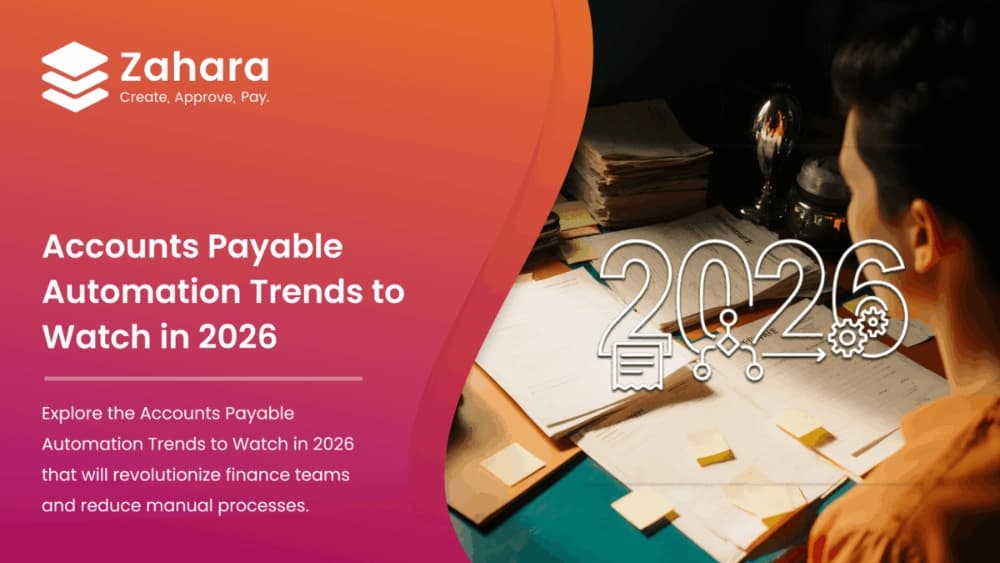
Accounts payable automation is moving fast. Finance teams are upgrading their systems because manual invoice handling wastes time, adds mistakes, and slows down month-end. 2026 will bring new tools, smarter workflows, and better controls.
This guide explains the key accounts payable automation trends for 2026 and how they will change the way finance teams work. It also shows how tools like Zahara help teams stay ahead.
Key Takeaways
Accounts Payable Automation Trends in 2026 focus on AI-driven processing, leading to faster invoice capture and fewer errors.
Embedding payments within automation systems enhances visibility and allows teams to approve payments in one place.
Self-service portals for suppliers improve communication and reduce back-and-forth, fostering stronger relationships.
Low-code tools simplify integration and allow finance teams to create workflows without needing developers.
These trends ultimately lead to increased efficiency, better cash control, and a smoother month-end process.
Accounts payable automation refers to software that handles invoice capture, coding, routing, approval, and payment without manual work.
By 2026, this process is more intelligent than ever.
Teams expect:
faster invoice capture
fewer errors
better reporting
strong audit trails
connected data across POs, invoices, and payments
Modern tools also reduce admin, cut month-end pressure, and speed up payment cycles.
For more detail on the software itself, see Accounts Payable automation software.
Finance teams face pressure to close the books faster.
Suppliers want real-time updates.
Leaders want better cash flow visibility.
Regulation around payments and reporting is getting tighter.
2026 creates a perfect moment for change.
Teams want tools that help them:
avoid mistakes
reduce fraud risk
keep documents organised
run approvals without delay
work from anywhere
view spending in real-time
These expectations shape the biggest trends for 2026.
AI now sits at the heart of accounts payable automation.
It handles documents with more accuracy than older OCR systems.
AI reads invoices in their natural layout.
It identifies suppliers, lines, totals, and dates automatically.
It understands context, not just text.
For details on OCR, see:
Systems match POs, GRNs, and invoices.
They spot common errors:
duplicate invoices
incorrect totals
mismatched purchase orders
missing data
Most invoices in 2026 need no manual coding.
fewer questions for suppliers
faster invoice approvals
fewer mistakes
better visibility
more predictable month-end cycles
Teams spend less time reading PDFs and more time improving processes.
Payments are moving inside AP automation systems.
Teams no longer switch between bank portals, spreadsheets, and ERPs.
Companies want a single place to approve and release payments.
They want full transparency over who was paid, when, and why.
See scheduled supplier payments for more detail.
Finance leaders can see:
which payments are pending
which are approved
which are blocked
which are urgent
No more guessing.
No more chasing.
With payments automated, the team focuses on cash flow, risk, and supplier management.
Approval workflows often slow down accounts payable.
2026 tools remove these delays.
Approvals adapt to:
invoice value
department
budget holder
supplier behaviour
spending patterns
The system selects the right route automatically.
This reduces errors and speeds up sign-off.
Teams are not tied to desks.
Approvers can sign off invoices from phones or tablets.
This shortens the end-to-end cycle.
Every change gets logged.
Every approval step is recorded.
See invoice approval software for more detail.
2026 AP automation platforms use AI to predict future spending.
This helps leaders prepare for:
supplier payment spikes
seasonal trends
contract renewals
risks around cash flow
The software learns from historical spending.
It provides insights that support budgeting and forecasting.
With better visibility, teams avoid the traditional “month-end rush.”
Data is clean throughout the month.
Finance leaders get accurate reports without last-minute pressure.
This fits neatly with your Construction campaign message about month-end struggles.
Suppliers expect clarity.
They want to know when invoices will be paid.
They want to upload documents without back-and-forth emails.
Self-service portals let suppliers:
upload invoices
check payment status
update details
track progress
This lowers inbox noise for AP teams.
If a supplier has an issue, they can raise it inside the portal.
This avoids long email threads.
Companies want strong supplier relationships.
Automation supports this by keeping communication consistent and clear.
With more digital invoices, fraud risk increases.
2026 tools help reduce it.
Every action is recorded.
This builds trust and supports compliance with internal controls.
AI highlights unusual behaviour:
new bank details
unusual invoice value
repeated supplier names
fake invoices
These alerts protect the business.
Approvals follow strict rules.
The right people sign off the right invoices.
This lowers risk and improves governance.
Integration used to require developers.
In 2026, low-code tools let teams build workflows themselves.
Teams can design rules, validation steps, and routes through simple on-screen tools.
Finance systems like Business Central, Xero, QuickBooks, and Sage connect more easily.
This supports your existing Dynamics 365 automation content and aligns well with invoice automation discussions.
Businesses want one joined-up view of:
purchase orders
receipts
invoices
payments
AP automation sits at the centre of this change.
This creates a full audit trail.
It also removes the gaps that cause disputes and delays.
Useful internal pages here:
Leaders see where money is committed before it leaves the business.
This avoids surprise costs and supports spending decisions.
These trends show a clear direction.
Teams want better visibility, predictable workloads, and fewer manual tasks.
The main benefits include:
faster invoice handling
fewer disputes
stronger supplier relationships
better cash control
consistent approvals
reduced risk
quicker month-end
clearer insight into spending
AP automation in 2026 is not just about saving time.
It helps finance teams work with more confidence.
Zahara aligns well with the trends shaping 2026.
It gives teams the tools to improve speed, accuracy, and control.
Here is a quick breakdown:
AI-powered invoice capture
automation for coding and matching
clear multi-step approvals
smart routing
payment runs inside one system
purchase order handling
three-way matching
full audit trails
duplicate detection
simple mobile approvals
multi-entity support
integrations with leading finance systems
Latest news, events, and updates on all things App related, plus useful advice on App advisory - so you know you are ahead of the game.
Connect with us